OpenAI Rolls Out GPT-5.4 Mini and Nano for Faster, Cheaper Production Workloads
OpenAI's smaller GPT-5.4 variants signal the part of the model market that actually ships: cheaper, faster tiers built for routing, bulk inference, and always-on product features.
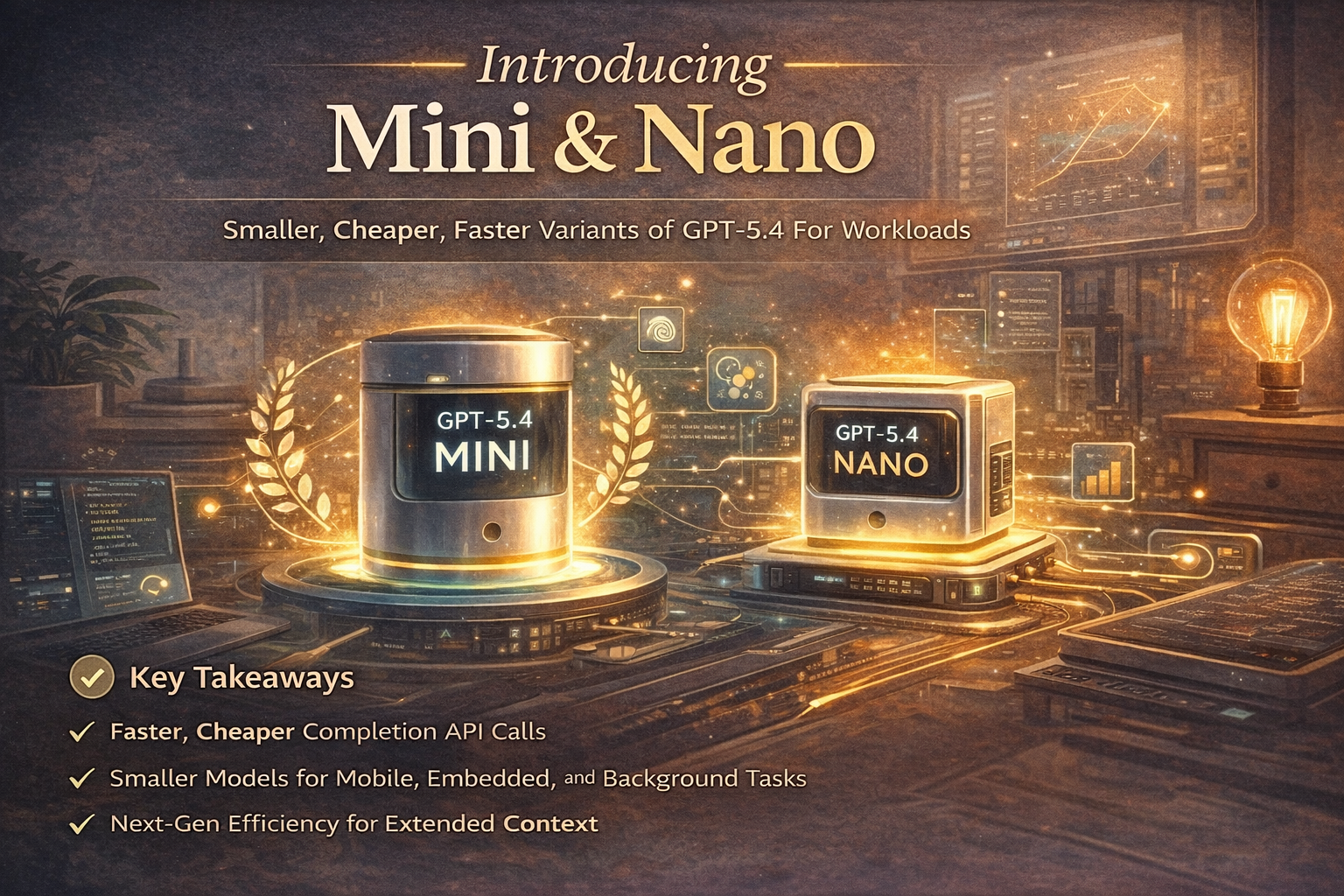
Bigger models attract the attention, but smaller models usually absorb the production volume. Routing, classification, extraction, fallback handling, and bulk background tasks all need models that are cheap enough to call often and fast enough to sit inside real product flows.
That is why GPT-5.4 mini and nano deserve a place in the blog. They are not exciting because they are maximal. They are exciting because they make practical model tiering easier for teams that actually have to ship and pay for inference.
- The model market is maturing into tiers instead of revolving around one flagship.
- Cheaper, lower-latency variants make multi-model product architecture more viable.
- Smaller models often decide whether AI features scale economically in production.
Why smaller variants matter so much
A lot of the most useful AI work inside applications is repetitive. Intent tagging, extraction, formatting, classification, routing, and simple drafting do not always need the most expensive model in the family. When lower-tier variants get good enough, the economics of shipping more AI features change immediately.
- Background jobs become easier to justify financially
- Always-on product features stop feeling dangerous to deploy at scale
- Teams can reserve premium inference for only the hardest user moments
This supports better system design
Strong AI products increasingly look like pipelines, not single prompts. A cheaper model can classify or summarize first, a larger model can step in when deeper reasoning is needed, and a fallback layer can keep latency stable. Releases like mini and nano are important because they make that architecture easier to afford and operate.
The winning question is less 'which model is best' and more 'which tier should own each step of the workflow.'
What this says about the market
Vendors now know buyers care about more than a flagship benchmark chart. They want a default model, a fast model, a cheap model, and a model they can trust for bulk production jobs. That is a healthier shape for the market because it maps to how products are actually built.
GPT-5.4 mini and nano are worth covering because they push the economics and architecture of real AI products in a useful direction.
For most builders, the cheaper production tier ends up being more important than the frontier headline model once the feature has to survive contact with scale.
Ready to try it yourself?
Get started with the tools mentioned in this article. Most have free trials - no credit card required.
Browse Matching Tools ->