Agentic Design Patterns, Part 2: The Workflow Patterns That Make Agents Reliable
Prompt chains, routing, parallelization, reflection, tool use, planning, and multi-agent coordination are the reusable patterns that turn model capability into system behavior.
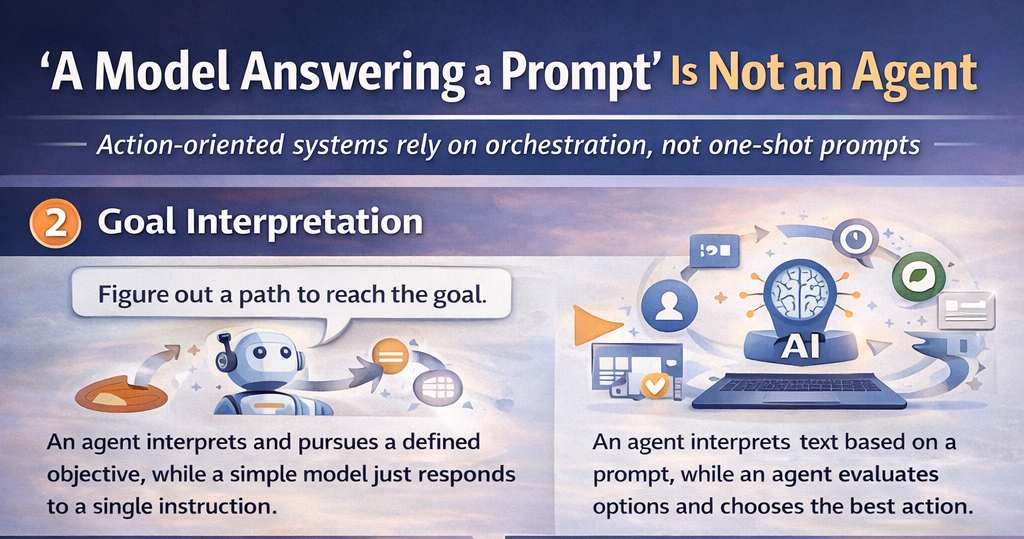
Once you stop calling every prompt an agent, the next question is what reusable patterns actually make agent systems work. The strongest part of the book summary is its answer: prompt chaining, routing, parallelization, reflection, tool use, planning, and multi-agent decomposition are not trends. They are recurring solutions to recurring problems.
That matters because the fastest way to build a bad agent is to improvise the workflow from scratch every time. Patterns give you a vocabulary for deciding when to add structure and why.
- Prompt chains improve clarity and debuggability but add latency and can propagate upstream mistakes.
- Routing and parallelization are practical answers to task heterogeneity and scale.
- Reflection, tool use, planning, and multi-agent decomposition all add power, but only when bounded by real system needs.
Prompt chaining is the first real upgrade
Prompt chaining is the entry point because it fixes the most common failure mode: asking one prompt to summarize, extract, transform, judge, and format all at once. Decomposing the work into smaller steps gives each stage a narrower job and makes debugging possible. You can improve a chain because you can inspect it. You cannot improve a monolith nearly as easily because you do not know which internal move actually failed.
Chains buy control and observability at the price of more latency and more places where early errors can leak forward.
Routing and parallelization are how systems scale
Routing exists because not every request deserves the same prompt, model, tool set, or workflow depth. Good routing sends easy work down cheap paths and harder work into deeper workflows. Parallelization exists because many jobs contain independent subproblems that should not wait on each other. Both patterns are really about operational efficiency, not elegance.
- Route heterogeneous tasks to specialized logic instead of forcing one generic path
- Parallelize independent work when aggregation is easier than sequential waiting
- Make the routing criteria and merge logic inspectable so failures stay diagnosable
Reflection and tool use change the ceiling
Reflection is one of the most important patterns because it converts generation into a loop instead of a one-time act. A critique step can catch weak evidence, shallow reasoning, formatting errors, or bad tool choices. Tool use changes the system's ceiling in a different way. Once the model can call APIs, browse, execute code, or inspect external state, it is no longer trapped inside its weights.
Both patterns are powerful, but both create failure surfaces. Reflection can become expensive or circular if you do not bound it. Tools create authorization, validation, and security problems the moment they touch the real world. The pattern only helps if the control layer is as serious as the capability layer.
Planning and multi-agent systems are not defaults
Planning is valuable for long-horizon tasks because it introduces explicit subgoals and a structure for revising them as reality changes. Multi-agent decomposition can be useful when role specialization genuinely maps to the problem. But the summary is right to resist romanticizing either one. Plans become brittle when detached from feedback, and multi-agent systems create coordination overhead, token cost, and debugging pain fast.
The right lesson is not that more agents or more planning is always better. It is that decomposition should match the structure of the job. If it does not, you are just multiplying moving parts.
The most useful workflow patterns in agent design are boring in the best way. They solve repeatable problems with repeatable structure.
That is why pattern vocabulary matters. It turns agents from improvisation into engineering.
Ready to try it yourself?
Get started with the tools mentioned in this article. Most have free trials - no credit card required.
Browse Matching Tools ->