50 ChatGPT Prompts for Lawyers: Research, Drafting, Contracts, and Client Work
A practical legal prompt library grounded in Thomson Reuters guidance on context, structure, and common prompting traps for higher-stakes legal work.
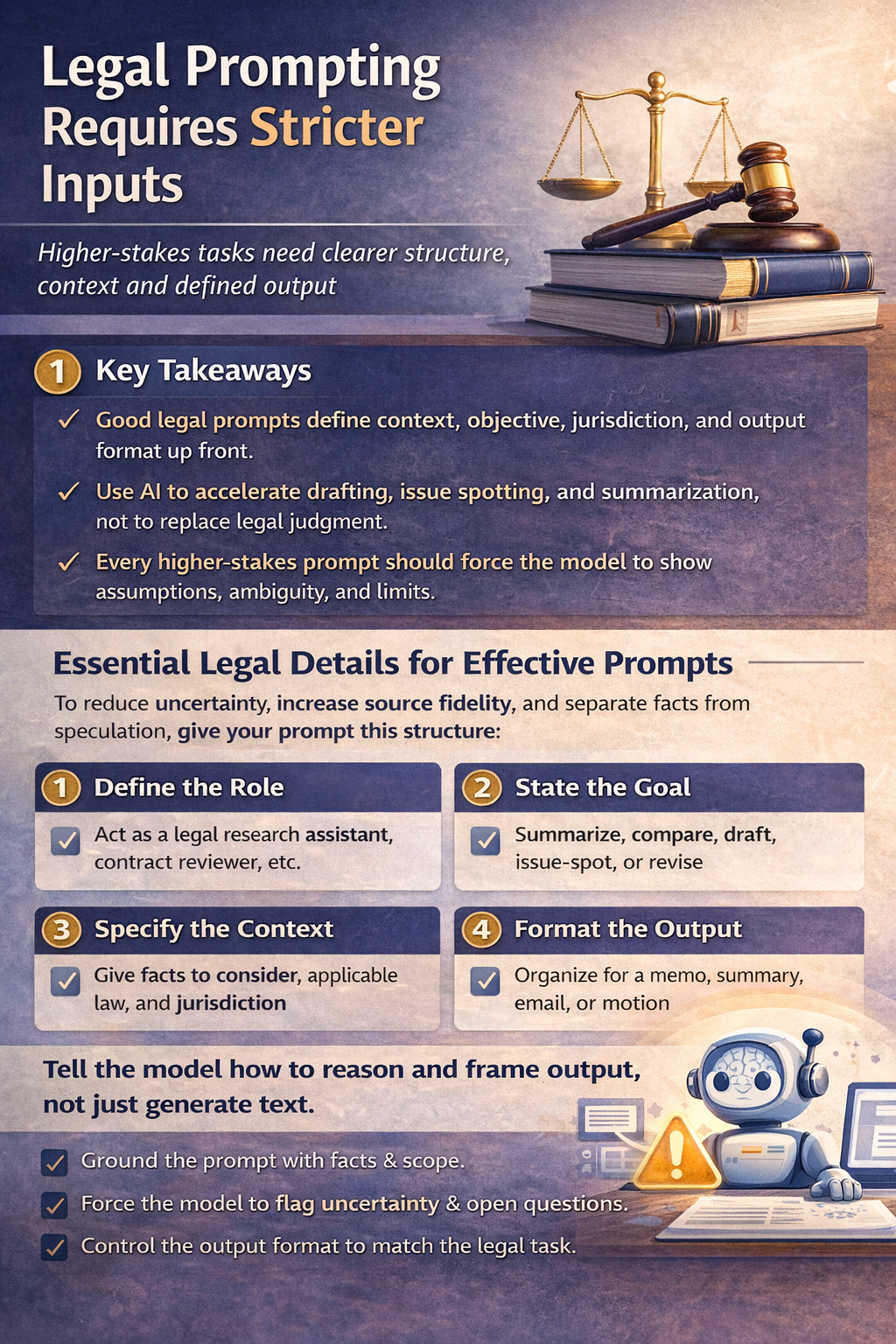
Legal prompting is not just normal prompting with fancier vocabulary. The stakes are higher, the need for source fidelity is stronger, and vague requests are much more likely to produce confident but unusable output.
The strongest legal AI guidance right now emphasizes structure: define the role, supply the relevant facts, specify the jurisdiction or document type, state the goal clearly, and force the model to distinguish between supported analysis and uncertainty.
- Good legal prompts define context, objective, jurisdiction, and output format up front.
- Use AI to accelerate synthesis, drafting, issue spotting, and summarization, not to replace legal judgment.
- Every higher-stakes prompt should force the model to show assumptions, ambiguity, and limits.
Why legal prompting needs tighter structure
Legal AI output improves sharply when the prompt gives the model real context and a bounded task. A legal prompt should tell the model what kind of professional lens to use, what facts or document text matter, what jurisdiction or contract context applies, and exactly what kind of answer is wanted.
- State the legal task: summarize, compare, draft, issue-spot, or revise
- Include the relevant facts, clause text, or document excerpt directly
- Specify jurisdiction, contract type, audience, and tone where relevant
- Force the model to separate supported analysis from open questions
If the matter would be risky to handle from memory, do not let the model work from memory either. Feed it the text and define the job narrowly.
Prompt templates for research and issue spotting
Act as a legal research assistant. Review the facts below and identify the 5 most important legal issues that should be analyzed first. For each issue, explain why it matters, what facts are most relevant, what information is still missing, and what kind of authority I should research next. Do not invent case law or statutes. If the facts are too incomplete for confidence, say that clearly.
Review the contract excerpt below for business and legal risk. Organize the response into: clause summary, primary risk, likely negotiation issue, fallback position, and questions for counsel review. Keep the language practical and specific. Highlight any ambiguity or missing definitions that could create downstream risk.
Compare Version A and Version B of the clause below. List every material difference in obligation, timing, liability, termination, indemnity, or remedies. Then explain the practical effect of each difference in plain English for a business stakeholder.
Prompt templates for drafting and client work
Draft a client update email based on the matter summary below. Tone: calm, clear, and professional. Explain what changed, what it means, what we still do not know, and what the client should expect next. Avoid unnecessary legal jargon. End with 3 likely client questions I should prepare for before sending.
Turn the notes below into a concise internal legal memo. Use sections for issue, relevant facts, preliminary analysis, open questions, and recommended next steps. Do not overstate certainty. Mark any point that requires primary-source verification before circulation.
Given the contract language and business objective below, propose 3 negotiation approaches. For each one include the likely legal benefit, business tradeoff, fallback language, and where the counterparty is most likely to push back.
Further reading on legal prompting
The strongest legal prompting guidance emphasizes context, specificity, and clear boundaries around what the model should and should not do. That matters in legal work, where a polished answer is not the same thing as a reliable one.
Read Thomson Reuters on writing effective legal AI prompts →Read Thomson Reuters on prompt design in legal work →Legal prompts work when they narrow the task, anchor the facts, and force the model to show where certainty ends.
That is the right way to use AI in legal workflows: faster synthesis and drafting, tighter issue framing, and human judgment exactly where it still matters most.
Ready to try it yourself?
Get started with the tools mentioned in this article. Most have free trials - no credit card required.
Browse Prompt Library ->