60 ChatGPT Prompts for Recruiters: Sourcing, Screening, Outreach, and Hiring Ops
Use recruiter-safe prompts for job descriptions, candidate screening, outreach, interview prep, and onboarding without turning hiring into generic AI sludge.
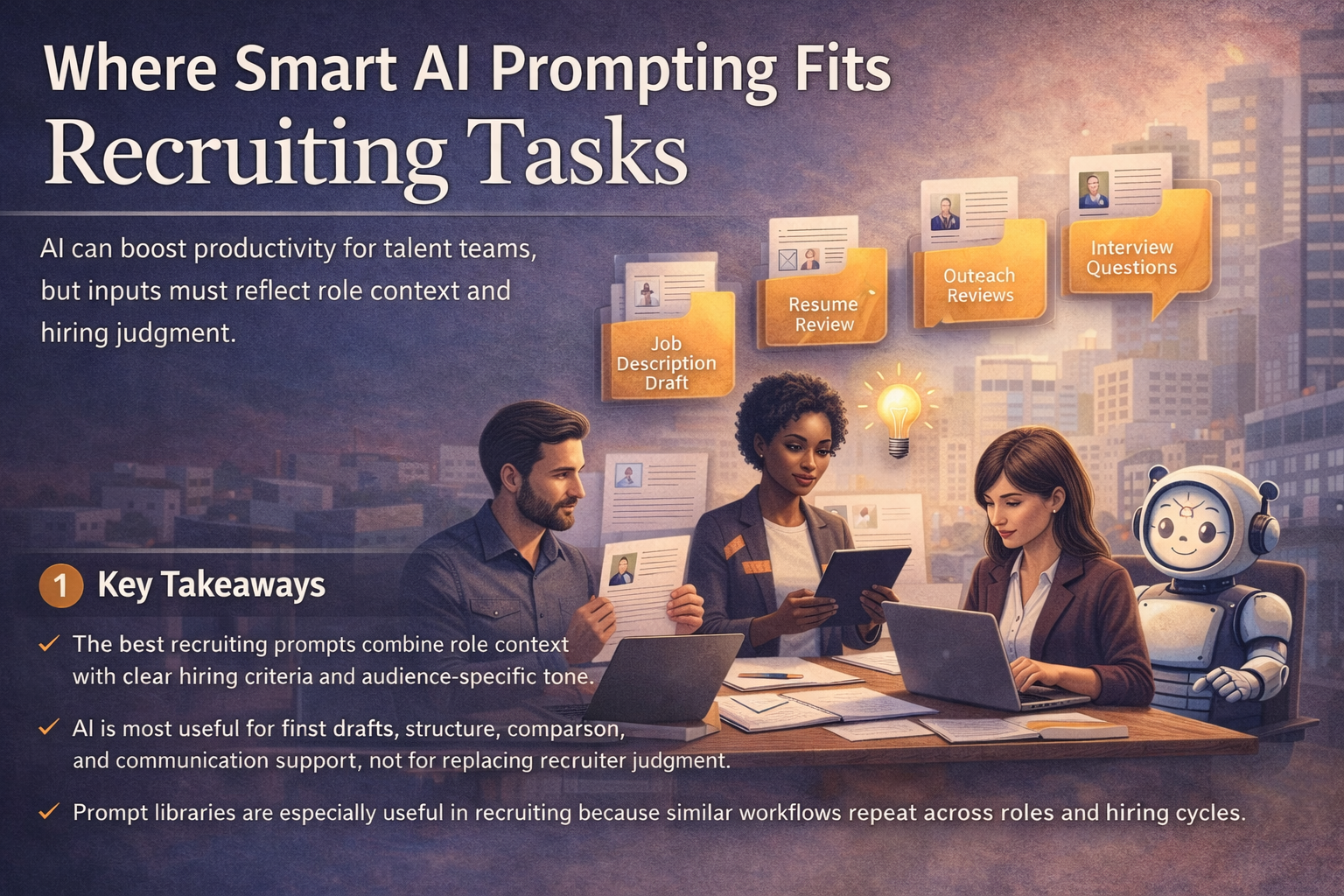
Recruiting is one of the better fits for AI prompting because so much of the work is repetitive but still language-heavy: job descriptions, outreach, screening criteria, interview prep, and candidate communication.
The catch is that recruiter prompts get weak fast when they produce generic copy or flatten real hiring context. Good prompts need the role, the hiring signal, the audience, and the constraints baked in from the start.
- The best recruiting prompts combine role context with clear hiring criteria and audience-specific tone.
- AI is most useful for first drafts, structure, comparison, and communication support, not for replacing recruiter judgment.
- Prompt libraries are especially useful in recruiting because similar workflows repeat across roles and hiring cycles.
Where recruiting prompts create the most leverage
The highest-leverage recruiting tasks for AI are screening resumes, drafting more useful job descriptions, improving inclusive language, writing outreach emails, generating interview questions, and helping teams make sense of hiring data. These are exactly the kinds of workflows where a reusable prompt stack can save time without forcing the recruiter to surrender judgment.
- Resume review and candidate-fit summaries
- Job description and hiring-manager alignment drafts
- Cold outreach, rejection, and nurture messaging
- Interview question creation and hiring-scorecard prep
Prompt templates for sourcing and screening
Review the resume and role brief below. Summarize the candidate's likely fit in 5 bullet points using only evidence from the resume. Then list 3 strengths, 3 risks or gaps, and 5 follow-up questions a recruiter should ask before advancing them.
Write a personalized first-touch outreach email for this candidate based on the profile notes below. Keep it under 140 words. Mention why their background aligns with the role, what would likely interest them about the opportunity, and give a clear low-friction CTA. Avoid hype and generic praise.
Rewrite this job description to make it clearer, more outcome-focused, and more candidate-friendly. Keep the must-haves realistic, reduce vague buzzwords, and include what success looks like in the first 90 days.
Prompt templates for interviews and hiring ops
Generate 10 interview questions for this role based on the responsibilities below. Separate them into: technical ability, collaboration, judgment, and role-specific problem solving. For each question, include what a strong answer should reveal.
Turn the interview notes below into a balanced debrief. Organize the output into strengths, concerns, evidence, open questions, and recommendation. Flag any statement that is opinion rather than evidence.
Draft a rejection email for a candidate we interviewed but are not advancing. Use a warm and respectful tone. Thank them for their time, close the loop cleanly, and avoid language that sounds automated or evasive.
Further reading on recruiting prompts
The most useful recruiting guidance stays close to real hiring workflows. It treats prompts as support for screening, outreach, interview prep, and structured evaluation rather than as a substitute for recruiter judgment.
Read Lever's ChatGPT use cases for talent acquisition teams →Read Workable on how ChatGPT helps recruiters get more done →Read Workable on using ChatGPT for better job descriptions →Recruiting prompts work best when they sharpen signal, save writing time, and keep the recruiter in charge of the actual hiring decision.
The best recruiting prompt sets stay tied to actual hiring workflows and leave the final judgment with the recruiter.
Ready to try it yourself?
Get started with the tools mentioned in this article. Most have free trials - no credit card required.
Browse Prompt Library ->